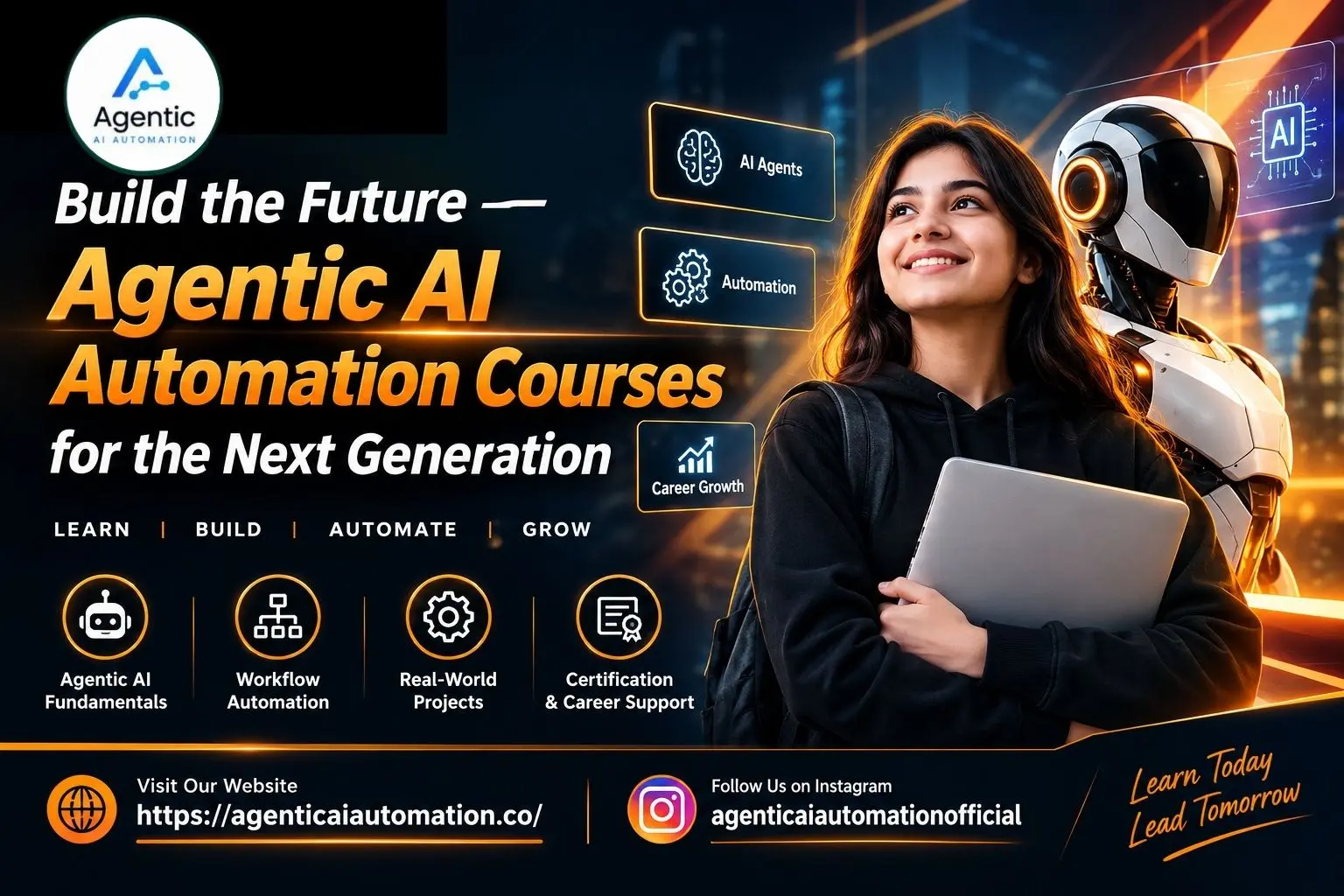
Learn Smarter Workflows with Agentic AI Automation Courses
A few years ago, "automation" meant a script that ran on a schedule and did one predictable thing. Type the input, get the output, nothing more. That world is gone. Today's software can plan, decide, and act across multiple steps without a human clicking "next" at every stage. That shift has a name — Agentic AI — and it's rewriting how businesses operate and how people build their careers.
If you've been hearing the term everywhere and wondering whether it's just another buzzword, it isn't. Companies are hiring for it, funding it, and restructuring entire teams around it. And that's exactly why Agentic AI Automation Courses have become one of the fastest-growing categories in tech education this year.
Let's break down what this actually means, why it matters, and how you can start learning it — without the hype.
What Makes Agentic AI Different
Most people picture AI as a chatbot. You ask a question, it answers. That's useful, but it's still a one-way conversation. An agent works differently. It takes a goal — "research three competitors and draft a summary" — and figures out the steps on its own. It searches the web, pulls data, checks its own work, and adjusts course when something doesn't fit.
Think of the difference this way: a chatbot hands you a fish. An agent goes fishing for you, checks the weather first, and brings back dinner.
That capability comes from combining a few things: a language model that can reason, a set of tools the model can call (search engines, databases, APIs, spreadsheets), and a loop that lets the system observe results and try again if the first attempt fails. Put those three pieces together and you get Agentic AI Automation — software that completes real, multi-step work with minimal supervision.
This isn't science fiction. Marketing teams already use agents to research prospects and draft outreach. Finance teams use them to reconcile spreadsheets and flag anomalies. Developers use them to write code, test it, and fix their own bugs. The pattern repeats everywhere: a task that used to take a person three hours now takes an agent twenty minutes, with a human reviewing the final output.
Why This Skill Set Matters Right Now
Every major hiring trend points the same direction. Job boards show a sharp rise in postings that mention "AI agents," "workflow automation," and "autonomous systems." Recruiters aren't just looking for people who can use ChatGPT — they want people who can design systems where AI does the heavy lifting and humans handle judgment calls.
Business owners feel this pressure too. A small team that adopts agentic workflows can suddenly compete with a much bigger competitor, because the agents handle the repetitive grunt work: data entry, report generation, customer follow-ups, inventory checks. The owner focuses on strategy while the software runs operations in the background.
None of this happens automatically, though. Someone has to build these systems, test them, and keep them safe and accurate. Agentic AI Automation Courses fill exactly that gap.
Who Actually Needs This Training
You don't need a computer science degree to start. The field splits roughly into three groups, and each one benefits differently.
Beginners and career switchers get a way into tech without years of traditional coding bootcamps. Many courses now teach no-code and low-code agent builders alongside basic Python, so you can build something functional in your first week.
Developers and technical professionals use these courses to go deeper — learning how to chain tools together, manage memory across long tasks, and handle errors gracefully so an agent doesn't spiral into repeated mistakes.
Business owners and managers don't necessarily want to build agents themselves, but they need to understand what's possible so they can direct a team, evaluate vendors, or automate their own operations without getting oversold on hype they can't use.
Whichever group you fall into, the fundamentals stay the same: you learn how agents reason, how they use tools, and how to keep them accountable.
What a Strong Agentic AI Automation Course Actually Teaches
Not every course delivers real skill. Some just walk through a flashy demo and call it a day. A course worth your time and money covers ground like this:
Foundations of large language models. You need to understand what these models are good at, where they fail, and why they sometimes make things up. Skipping this step leads to agents that look impressive in a demo and fall apart in production.
Tool use and function calling. This is the mechanism that lets an agent search the web, query a database, or send an email instead of just generating text. A good course walks you through building and connecting these tools step by step.
Planning and reasoning loops. Here's where the "agentic" part lives. You'll learn how a system breaks a big goal into smaller steps, checks its progress, and decides what to do next — including when to ask a human for help.
Memory and context management. Long tasks require the agent to remember what it already did. Courses that skip this leave students unable to build anything beyond a single-step demo.
Safety, guardrails, and human oversight. An agent that can take real actions — sending money, deleting files, emailing customers — needs limits. This might be the most overlooked topic in weaker courses, and it's exactly where the best ones spend real time.
Real project work. The strongest courses end with you shipping something: a research assistant, a customer support agent, an inventory tracker. Reading slides teaches theory. Building something that runs teaches skill.
If a course you're considering skips most of this list, keep looking.
The Skills You Walk Away With
By the end of a solid program, you should be able to design a workflow, connect an AI model to real tools, test the system against edge cases, and explain — in plain language — why the agent made the choices it made. That last part matters more than people expect. Employers don't just want output; they want someone who can debug a system when it behaves strangely at 2 a.m.
You'll also pick up transferable habits: breaking big problems into smaller ones, thinking in terms of feedback loops, and building in checks before trusting automation with anything important. Those habits carry over into regular software work, project management, even personal productivity.
The Career and Business Payoff
For individuals, this training opens doors in roles that barely existed two years ago: AI automation specialist, agent engineer, workflow architect. Salaries in these roles already run well above average tech pay in many markets, and demand keeps climbing faster than supply.
For business owners, the payoff shows up in hours saved and errors reduced. A well-built agent doesn't get tired on the fortieth support ticket of the day or forget to follow up with a lead. It handles volume that would otherwise require hiring more staff, and it does so at a fraction of the cost.
The catch is that none of this happens without someone who understands both the technology and the business problem it's solving. Agentic AI Automation Courses exist to build exactly that combination of skills.
How to Choose the Right Course
With so many options flooding the market, picking one can feel overwhelming. A few filters help narrow things down fast.
Check whether the course builds real projects or just shows slides and demos. Look at who teaches it — practitioners who've shipped agentic systems teach differently than people repeating theory from a textbook. Read what past students say about the pacing and the support they got when stuck. And check how often the instructors update the material, since this field changes month to month, not year to year.
Price matters less than most people assume. A free course that teaches outdated concepts wastes more of your time than a paid one that stays current. Judge the content, not the price tag.
Getting Started Without Overthinking It
You don't need to master everything before you begin. Start with one small project: an agent that reads your emails and drafts short replies, or one that pulls data from a spreadsheet and writes a summary. Small wins build the intuition that bigger projects need later.
Agentic AI isn't a passing trend — it's fast becoming the standard way teams build software and run businesses. The people and companies who learn to work with it early will set the pace for everyone else. The good news is that the learning curve, while real, isn't as steep as it sounds. A well-structured course, a bit of consistent practice, and a genuine project to build against will take you further than you'd expect in just a few weeks.
The future runs on systems that can think, plan, and act. Learn to build them now, and you take a seat in the room where people design that future, instead of watching it happen from the sidelines.
A Few Quick Questions People Ask
Do I need to know how to code first?
No. Many beginner-friendly courses start with no-code or low-code tools, so you can build a working agent before you write a single line of Python. Coding helps later, when you want more control, but it's not a starting requirement.
How long does it take to get job-ready?
Most learners see real progress within four to eight weeks of consistent practice, though "job-ready" depends on the role. A support-automation specialist role might need less depth than an agent-engineering role at a larger company.
Can a small business really use this without hiring a developer?
Yes, to a point. Plenty of no-code platforms let a business owner build simple agents — appointment reminders, lead follow-ups, basic reporting — without touching code. Complex, multi-tool systems still benefit from someone with real training, which is exactly where a solid course pays for itself.