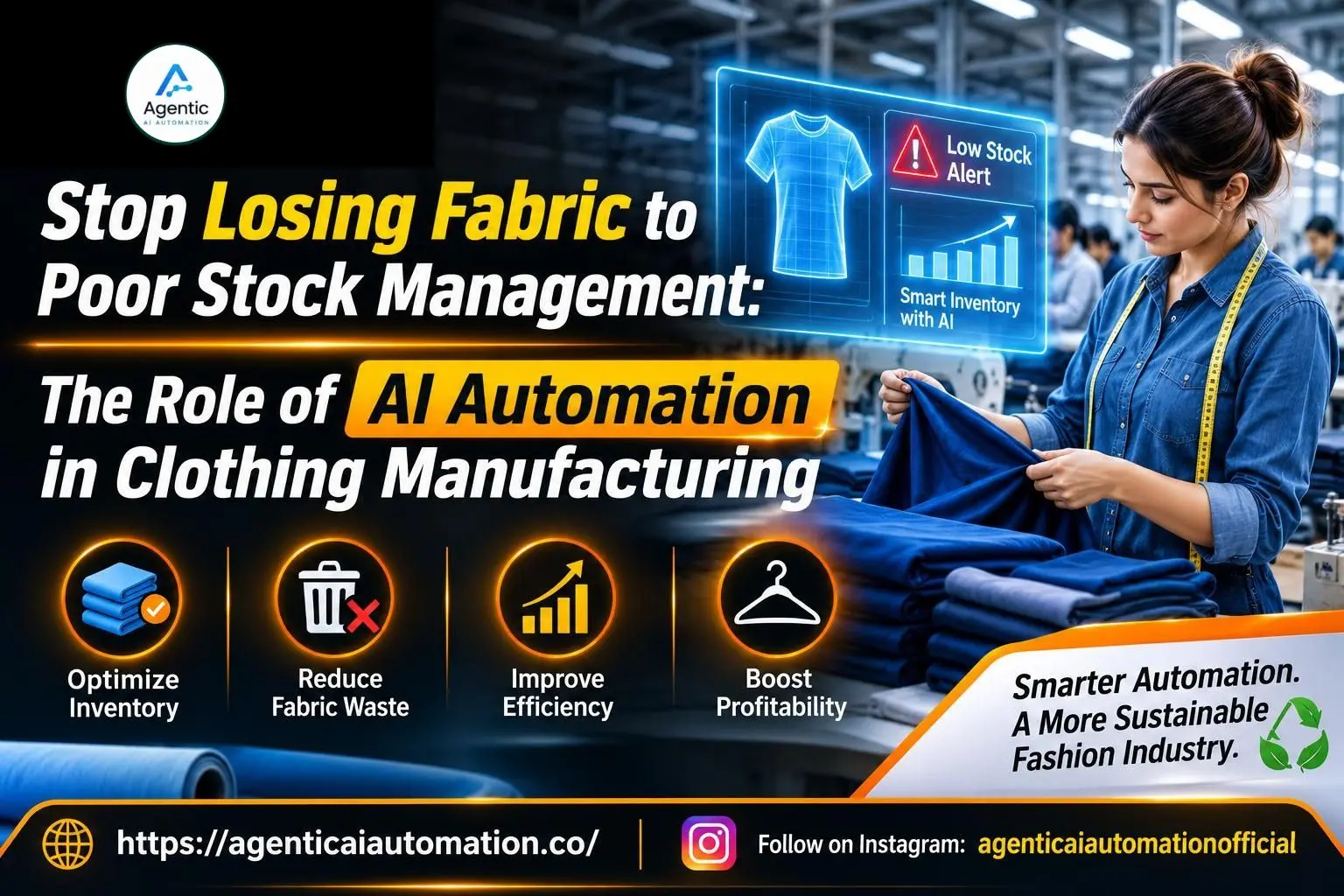
Stop Losing Fabric to Poor Stock Management: The Role of AI Automation in Clothing Manufacturing
TL;DR
- Fabric is one of your biggest costs, and most of it leaks out quietly: wrong roll counts, forgotten end-bits, late reorders.
- AI can track fabric, thread, buttons and zips in real time and send an alert when stock runs low. That is the practical core of automation in garment manufacturing.
- Start with one store room and one cutting table. A good AI automation clothes manufacturing company will show results there before it asks you to change anything else.
Who this is for: Owners and managers of small and mid-size garment units who still track fabric in registers, WhatsApp messages or Excel sheets. Ask any store manager where last month’s missing fabric went, and you will probably get a shrug. A roll got counted twice. A cutter picked the wrong width. Or it is sitting behind the trims rack, forgotten. Nobody knows. That “nobody knows” is the real problem. Fabric often makes up the largest share of a garment’s cost. When a roll goes missing on paper, you lose twice: once for the cloth, and again when the order stalls. Some industry research puts the loss from poor cutting and material handling at 15 to 20 percent of fabric. Your number may be lower. You will not know until you measure it.
Where Fabric Really Goes Missing
Most owners look at the cutting table first. Reasonable, but the leak usually starts earlier. Here is the full path, and what an automated system does at each step.
| Stage | What goes wrong | What the system does |
|---|---|---|
| Receiving | The packing list says 100 metres; nobody checks the roll. | Staff scan each roll on arrival. The system flags any gap against the purchase order. |
| Storage | Rolls get moved, stacked and forgotten. The register is not updated. | Barcode or RFID tags give every roll a live location. |
| Cutting | End-bits and leftover pieces get thrown away. | The software suggests where to use end-bits in the next lay. |
| Reordering | Someone notices the shortage only when the line stops. | An alert goes out when stock drops below a set level. |
| Trims | Buttons, zips and thread are counted by eye. | Counts update each time an issue slip is scanned. |
What AI Actually Does in Stock Management
Let’s keep this simple. AI does not replace your store manager. It takes over the counting and the watching, two jobs that people do badly at 6 p.m. on a Friday.
The basic setup works like this. Every fabric roll, thread cone, button box and zip carton gets a barcode or RFID tag. Staff scan the item when it arrives, moves, or goes to the cutting room. The software reads those scans and keeps a running balance. The AI part studies how fast you use each material, compares that with your open orders, and predicts when you will run short.
When stock falls below a safe level, the system sends an alert to your phone, your email or the purchase team’s dashboard. A buyer sees “Navy zips: 4 days left” and places the order before the line stops. Nobody has to remember to check.
This is the kind of system a capable AI automation clothes manufacturing company builds for you: scanning, a stock database, and rules that trigger alerts. It can also connect to cutting-room planning, which is where the biggest savings tend to show up.
Smart Stock Tracking: AI tracks fabric, monitors stock levels, predicts shortages, and sends automatic alerts before raw materials run out.
Beyond Fabric: Thread, Buttons and Zips
Fabric gets the attention, but trims stop more lines than cloth does. A missing carton of zips can freeze 500 finished-looking jackets just as surely as a missing roll.
The same scan-and-alert method covers every raw material. The system holds a minimum level for each item. Thread cones, buttons, zips, labels and elastic all get one. When a scan drops the balance below that level, the buyer gets a message. If a supplier usually needs ten days to deliver, the alert fires ten days earlier, not on the day the box runs empty.
Over time, the AI also notices patterns that people miss. It may see that one style burns through thread faster than planned, or that a certain supplier always delivers a few days late. Those small signals help you order smarter, not just faster.
A Morning in the Store Room: Before and After
A quick note first. This walk-through shows a typical workflow. It is not a named client.
Before. The cutting supervisor asks for 600 metres of grey twill. The store keeper opens the register, finds the entry and walks to the rack. Two rolls are there. A third, listed in the register, is missing. It went to sampling last week, and nobody wrote it down. The supervisor waits. The line waits.
After. The supervisor places the request in the system. The screen shows three rolls and their locations: two on rack C4, one in sampling. The store keeper scans the two rolls out. By 10 a.m., the system has also noticed that grey thread will run out in three days at the current pace, and it has sent the purchase team an alert.
Nothing magical happened. The system kept the count honest and told the right person at the right time.
Real Example: Duc Hanh Garment, Vietnam
Duc Hanh is a Vietnamese garment maker that produces roughly 2.2 million pieces a year for brands such as Polo Ralph Lauren. Before the change, the team ran its cutting room on manual processes and Excel spreadsheets. Visibility was limited, and fabric forecasting was slow and imprecise.
The factory then adopted IntelloCut, an AI-backed fabric planning system from Coats Digital. Here is what the published case study reports:
| Measure | efore | After |
|---|---|---|
| Planning method | Manual work in Excel spreadsheets | AI-backed system with real-time planning |
| Cutting-room visibility | Limited | Full, real-time view of the cutting process |
| Fabric waste | Starting figure not published | About 1.95% soon after go-live; 1.7% over three years |
| Bill of materials (BOM) | No baseline published | About 2.2% saving |
Two points of fairness. First, these numbers come from case studies that the software vendor published, and the starting waste percentage is not stated, so treat them as a guide and not a promise. Second, IntelloCut focuses on cutting-room and fabric planning, which is one slice of stock control, not the whole of it. Other factories report similar gains. NST, a garment exporter in the Philippines, cut fabric wastage by 1% and produced 1% more garments from the same fabric. Univogue Group cut its cutting-room planning and execution time by 82%. Small percentages, yes. But on a large order book, a small percentage of fabric is a lot of cloth.
What It Costs and How Long It Takes
Prices change with vendor, factory size and the number of sites, so this post does not quote figures it cannot back up. The table shows where the money goes and how long each step normally takes. The time column holds planning estimates, not guarantees. Ask each vendor for a written quote against every line.
| Item | One-time | Monthly | Time |
|---|---|---|---|
| Stock audit and data clean-up | Staff time, or a small consulting fee | None | 1–2 weeks |
| Barcode/RFID labels and scanners | Hardware; depends on number of stations | Label stock | 1–2 weeks |
| Software set-up and ERP link | Vendor quote | None | 2–6 weeks |
| Software subscription | None | Vendor quote (often per user or per site) | Ongoing |
| Staff training | Staff time | Short refresher sessions | About 1 week |
| Pilot: one store, one cutting table | Covered by the lines above | Covered by the lines above | 1–3 months |
How to Start Without Breaking Anything
You do not need to rebuild the factory. Automated clothes manufacturing works best when you grow it in small steps.
- Count everything once. Run a full physical count and put it in one clean sheet. Bad data in means bad alerts out.
- Pick one material group. Begin with fabric. Add thread, buttons and zips after the first month.
- Tag and scan. Label every roll and box. Teach staff to scan at three points: in, move, out.
- Set alert levels. A simple rule works: daily use multiplied by supplier lead time, plus a small safety buffer.
- Review every week. Compare the system’s count with the shelf. Fix the gaps while they are small.
Mistakes That Waste the Investment
- Buying software before cleaning the data. The system will only repeat your old errors, faster.
- Skipping the floor staff. If the store team does not scan, the AI has nothing to learn from.
- Automating everything at once. A pilot teaches you more than a launch.
- Trusting a demo over a reference. Ask to speak with a factory that already runs the system.
Questions to Ask Before You Pick a Partner
Choosing the right AI automation clothes manufacturing company matters as much as the technology. Put these questions to every vendor:
- Can you show a client with a factory size and product mix like mine?
- Who verifies the waste and savings numbers, and how?
- Does your system connect with my existing ERP or accounting software?
- Who trains my staff, and for how long?
- If I leave, who owns my data, and can I export it?
The Bottom Line
Automation in garment manufacturing sounds like robots and huge budgets. In practice, it starts with a barcode and an honest count. Your team scans, the software watches, and the right person gets a message before a shortage turns into a stopped line.
If you want to test it, take one store room, measure one month of current fabric loss, and ask two vendors to quote a pilot. The numbers will tell you what to do next.
Next step: https://wa.me/917982881739 Message us on WhatsApp