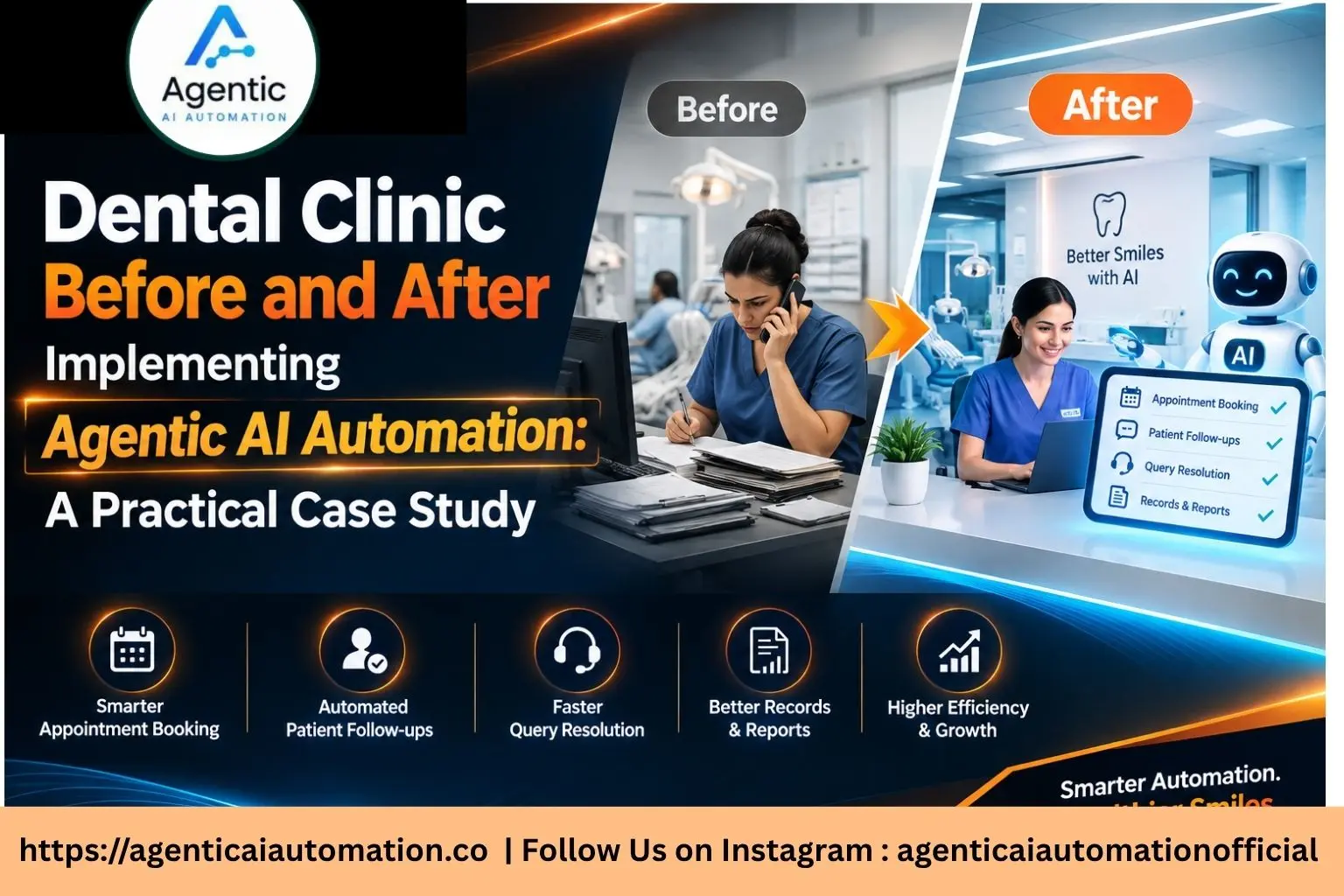
Dental Clinic AI Automation: Before and After Implementing Agentic AI Automation
If you run a dental clinic, this scene probably feels familiar: the phone won't stop ringing, WhatsApp is stacking up with enquiries, and your front desk is trying to juggle bookings, reminders, and walk-ins all at once. Somewhere in that chaos, patients slip through the cracks — and so does revenue.
This is exactly what happened at a mid-sized dental clinic before it adopted Dental Clinic AI Automation. What follows isn't a theoretical pitch — it's a real, practical look at what changed when the clinic brought in Agentic AI Automation to handle the daily grind of patient communication and scheduling.
The Problem: Too Many Patients, Too Little Bandwidth
The clinic was busy — genuinely busy. On an average day, it received anywhere between 40 and 50 patient enquiries through WhatsApp, phone calls, and the website. That's a good problem to have, except the receptionist was the only one handling all of it: scheduling appointments, answering repetitive questions, managing cancellations, and making follow-up calls.
During peak hours, calls got missed. Some patients who enquired never actually booked, simply because nobody followed up in time. Reminders were sent manually, if at all, and whenever a patient cancelled, that empty slot usually stayed empty because there was no system to quickly refill it. The result was a lot of hours spent on administrative work — hours that should have gone into patient care instead.
The Shift: Bringing in Agentic AI Automation
The clinic decided to implement Agentic AI Automation to take over the repetitive parts of patient communication. Unlike a simple chatbot that just answers FAQs, this system could actually understand incoming enquiries, share relevant information with patients, check available appointment slots, and complete the booking on its own.
Once an appointment was confirmed, patients automatically received WhatsApp reminders, so there was no more depending on someone remembering to send them manually. If a patient cancelled, the system identified the newly open slot and triggered a follow-up workflow with waiting patients or fresh enquiries, so that slot rarely stayed empty for long.
Perhaps the most valuable piece: patients who came in for a consultation but didn't book treatment on the spot weren't simply forgotten. The system scheduled personalised follow-up messages automatically, gently nudging them back without anyone on staff having to remember or find the time to do it.
Before vs. After: What Actually Changed
Before Agentic AI Automation
● Manual appointment booking for every enquiry
● Missed calls and delayed replies during peak hours
● Reminders sent manually, when there was time
● Time-consuming, inconsistent patient follow-ups
● Empty slots after cancellations, with no quick fix
● A receptionist carrying a heavy, constant workload
After Agentic AI Automation
● Automated enquiry handling round the clock
● Faster, near-instant patient responses
● Automated appointment reminders sent without fail
● Systematic, consistent follow-ups for every patient
● Better appointment-slot utilisation after cancellations
● Far less repetitive administrative work for staff
The Real Lesson Behind the Case Study
Here's the thing this clinic's story really proves: the problem was never the doctors' capacity to treat patients. The real bottleneck was that repetitive communication and administrative work were being managed entirely by hand.
Agentic AI Automation connected these workflows and let them run on their own, which freed up the staff to focus on patients and clinic operations instead of chasing follow-ups and juggling a ringing phone.
This is really what Agentic AI for Healthcare is about — not replacing the human side of care, but taking the repetitive, rule-based tasks off a team's plate so they have room to actually do the work that needs a human touch. For dental clinics specifically, that means fewer missed enquiries, better-utilised chair time, and a front desk that isn't stretched thin every single day.
If your clinic is dealing with the same before-picture — missed calls, manual reminders, empty slots after cancellations — it might be worth asking whether the issue is really about hiring more staff, or about automating the workflows that are eating up everyone's time. For this clinic, the answer was clear, and the after-picture speaks for itself.