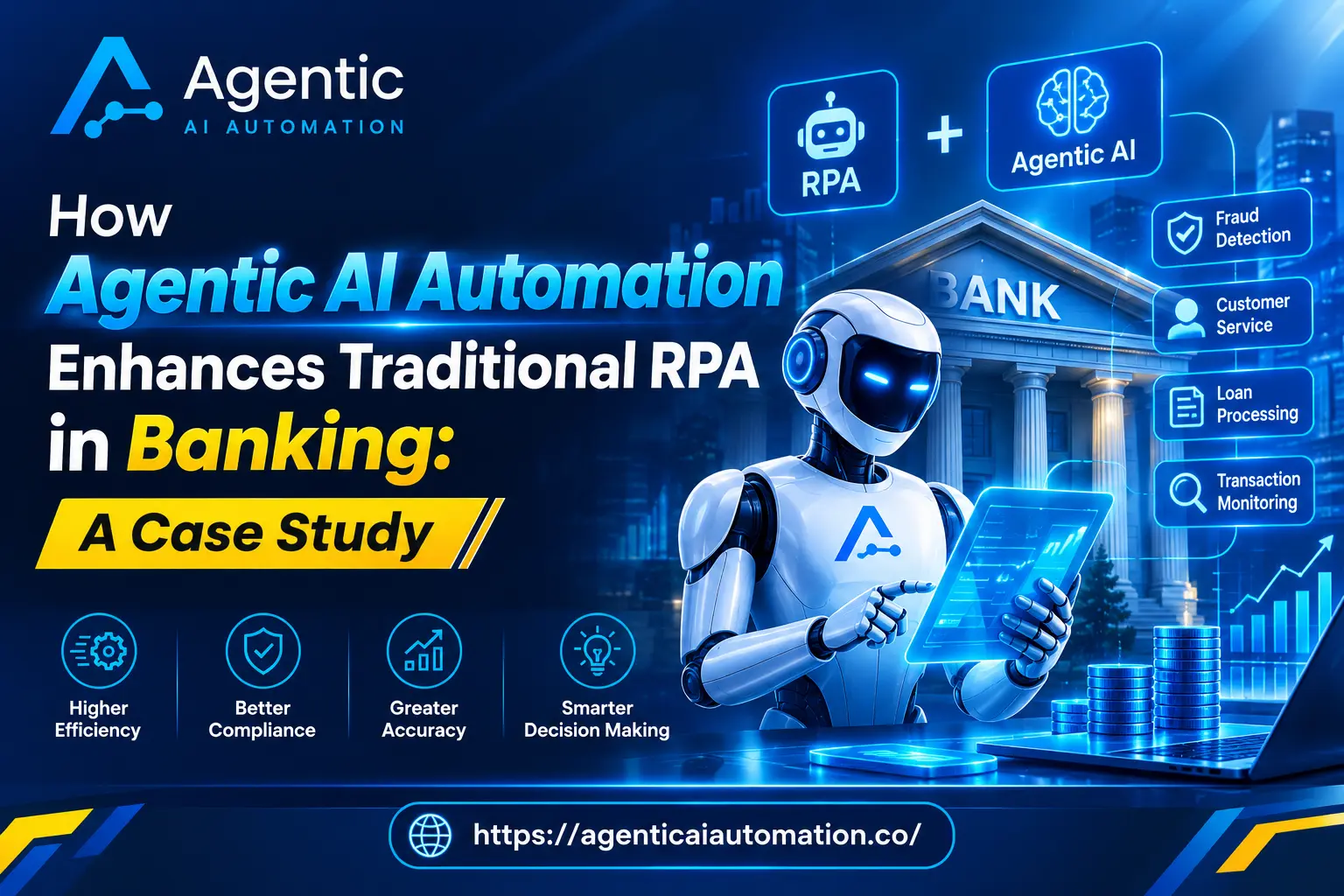
Understanding the Shift from Traditional RPA to Agentic AI Automation in Banking
Most banks didn't wake up one day and decide their robotic process automation program had failed. It just quietly stopped delivering the returns it used to. Bots that once saved thousands of hours a year started needing constant babysitting. Every time a vendor updated a screen layout or a regulator tweaked a form, someone had to rebuild the automation from scratch.
That's the backdrop for one of the more interesting shifts happening in banking IT right now: the move from rules-based bots to Agentic AI Automation. This isn't about throwing out RPA. It's about giving it a brain. In this piece, I'll walk through what that actually looks like, using a real-world style case study from a mid-sized regional bank that rebuilt its loan operations around this hybrid approach.
What Traditional RPA Does Well (and Where It Breaks Down)
Let's give RPA its due first. Robotic process automation is fantastic at repetitive, high-volume, rules-based work. Think data entry, reconciliations, or moving information between two systems that don't talk to each other natively. Banks have used it for years to automate account opening steps, KYC document routing, and nightly batch reconciliations.
The catch is right there in the phrase "rules-based." A traditional bot follows a fixed script. It clicks the same buttons, in the same order, on the same screen, every single time. The moment something outside that script happens — a missing field, an unexpected document format, a system outage — the bot stops. It doesn't guess. It doesn't adapt. It just waits for a human to fix it.
In banking, that's a real problem. Loan files, dispute cases, and compliance checks are full of exceptions. Studies of enterprise automation programs consistently find that somewhere between 30% and 50% of RPA use cases stall out or get scrapped within two years, mostly because the process changed and the bot didn't.
What Makes Agentic AI Automation Different
Agentic AI Automation flips the model. Instead of scripting every click, you give an AI agent a goal, access to tools and data, and the judgment to figure out the steps on its own. The agent can read an unstructured document, reason about what's missing, ask a clarifying question, call an API, or hand off to a human when it hits a genuine gray area.
Picture a mortgage exception queue. A rules-based bot sees a pay stub in an unfamiliar format and stops cold. An agentic system reads the pay stub, extracts the income figures even though the layout is new, cross-checks them against the application, and only escalates if the numbers genuinely don't reconcile. It's the difference between a machine that follows instructions and one that pursues an outcome.
That said, agentic systems aren't a replacement for the plumbing RPA already built. Banks have thousands of stable, low-risk bots doing exactly what they were designed to do. Ripping those out would be wasteful. The smarter move — and the one more banks are taking — is combining the two, using AI with RPA working side by side rather than one replacing the other.
Case Study: A Regional Bank's RPA to Agentic AI Migration
The Starting Point
A composite example drawn from patterns common across mid-sized U.S. regional banks illustrates this well. The bank — call it a $40 billion-asset regional lender — had built out a fairly mature RPA program over six years. More than 200 bots handled loan origination steps, fraud alert triage, and regulatory reporting.
The problem wasn't that RPA failed. It was that the bank had hit a ceiling. Straight-through processing on residential loans had plateaued around 61%. Every exception — an inconsistent W-2, a name mismatch between documents, an address that didn't match the credit bureau file — dropped into a manual review queue. That queue had grown to the point where average exception handling took over two days.
The Trigger for Change
The bank's operations team ran the numbers and found that bot maintenance alone was eating 140 hours a month across the IT team. Every regulatory form update or vendor portal redesign meant re-recording scripts. Leadership described it as "running to stand still." That's the moment they began exploring an RPA to agentic AI migration banking case study approach internally, piloting it first in the loan exceptions queue because that's where the pain was sharpest.
What They Actually Built
Rather than a rip-and-replace project, the team layered an agentic orchestration layer on top of their existing bots. The existing RPA bots kept doing what they were good at: pulling data from core banking systems, updating records, and triggering downstream workflows. A new AI agent sat above them, handling the judgment calls the bots couldn't make.
• Document understanding: the agent read unstructured pay stubs, tax forms, and letters of explanation, extracting and normalizing data regardless of format. • Exception reasoning: when a bot flagged a mismatch, the agent investigated the discrepancy across multiple systems before deciding whether to auto-resolve it or escalate. • Dynamic orchestration: the agent decided which bot to call next based on the specific case, instead of following one fixed sequence for every loan. • Human-in-the-loop escalation: genuinely ambiguous or high-risk cases still went to a human underwriter, with the agent's reasoning attached so reviewers weren't starting from scratch. The rollout took about four months, starting with a narrow pilot on 15% of loan volume before expanding bank-wide. Compliance and risk teams were involved from day one, since any system making judgment calls on lending decisions needs an audit trail regulators can actually follow.
How Agentic AI Automation Enhances RPA, Rather Than Replacing It
The case study above points to a broader pattern worth naming directly. Banks that get the best results aren't choosing between RPA and agentic AI. They're combining them, and each layer plays to its strength.
• Speed and cost: bots remain cheaper and faster for high-volume, unchanging tasks like data transfers and batch reconciliations. • Judgment and adaptability: agents handle the messy, unstructured, exception-heavy work that used to require a person. • Resilience: when a source system changes, the agent can often adjust its approach instead of breaking outright. • Governance: agents can generate a reasoning trail for each decision, which actually makes audits easier than a black-box script.
This layered model also lowers risk. Banks don't have to bet the whole operation on a new technology. They can add an agentic layer on top of automation that already works, test it on a narrow use case, and expand once they trust the outcomes.
Key Lessons for Banks Considering the Shift
A few lessons from this kind of migration tend to repeat across the industry, regardless of the specific bank or vendor involved.
Start with a painful, well-bounded process rather than a bank-wide overhaul. Loan exceptions, dispute resolution, and KYC remediation are common starting points because the pain is measurable and the scope is contained.
Bring compliance and risk teams in early. Regulators care less about the technology label and more about whether decisions are explainable, auditable, and consistent. An agent that can show its reasoning tends to pass scrutiny far more easily than one that can't.
Keep your existing bots. There's no need to discard a working RPA estate. Most successful migrations treat existing bots as tools the agent can call, not as legacy systems to tear out.
Measure the maintenance burden, not just the throughput. The maintenance-hour drop in the case study above mattered as much to leadership as the processing-time improvement, because it freed up engineers for higher-value work instead of constant bot repair.
Getting Started: A Practical Roadmap
Banks exploring this path generally move through four stages. First, they audit the existing RPA estate to find bots with high exception rates or heavy maintenance costs — these are the best pilot candidates. Second, they select one process, usually loan exceptions or fraud alert triage, where an agent can add clear judgment value.
Third, they build the agent with tight guardrails, defined escalation rules, and full logging from day one, rather than adding governance after the fact. Fourth, they expand gradually, using the metrics from the pilot to justify further investment rather than committing to a large program upfront.
This staged approach keeps risk manageable while still delivering the kind of results the case study above shows: faster processing, fewer manual escalations, and an automation program that adapts instead of breaking every time something changes.
The Bottom Line
Robotic process automation isn't going away, and it shouldn't. It's still the fastest, cheapest way to handle predictable, high-volume banking tasks. But banks that pair it with Agentic AI Automation are unlocking a level of adaptability that rules-based bots were never designed for. The winning strategy isn't RPA versus AI. It's AI with RPA, working together, with each one doing what it does best.
For banks still running on bots that break every time a form changes, that gap between what's possible and what's currently in production is often the biggest opportunity sitting on the table.