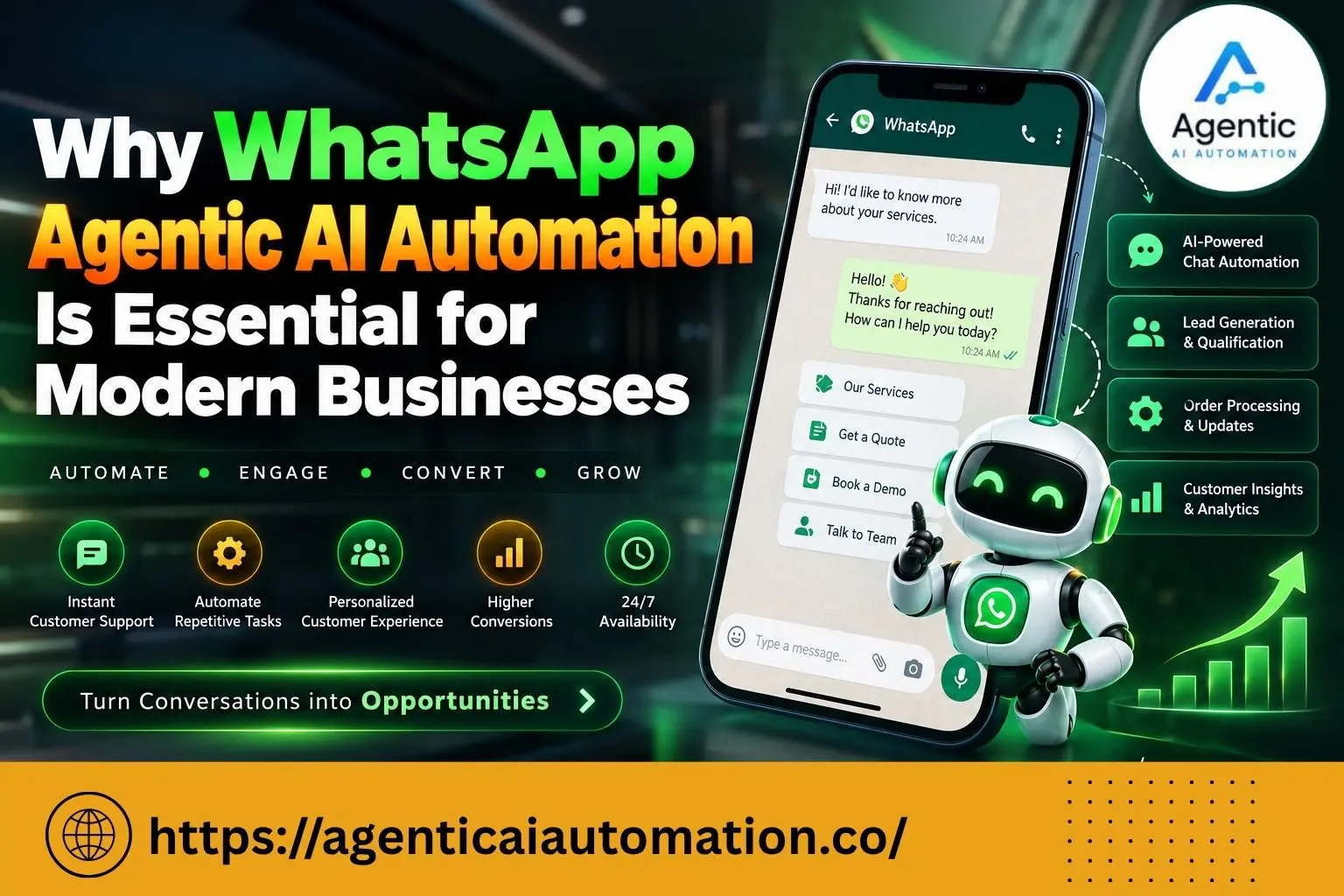
WhatsApp Automation for Smarter Business Workflows
If you run a business today, chances are your customers are already messaging you on WhatsApp — asking about order status, pricing, refunds, or just saying "hi, are you open?" at 11 PM on a Sunday. The problem isn't that people are messaging you. The problem is that most businesses still handle those messages the same way they did five years ago: a person, a phone, and a lot of missed conversations.
That's where WhatsApp Automation comes in, and more specifically, where WhatsApp Agentic AI Automation changes the entire game. This isn't just another chatbot buzzword. It's a real shift in how businesses talk to customers, close sales, and run operations without burning out their support teams. In this post, we'll break down what it actually means, why it matters right now, and how agentic ai is quietly becoming the backbone of serious business process automation strategies.
What Is WhatsApp Agentic AI Automation, Really?
Let's clear up the confusion first. A regular chatbot follows a script. You type "1" for sales, "2" for support, and it walks you down a rigid decision tree. It's fine, but it's also frustrating the moment your question doesn't fit the menu.
Agentic AI Automation is different. Instead of following a fixed script, an AI agent understands intent, makes decisions, takes actions across multiple systems, and follows through on a task from start to finish — without a human nudging it at every step. On WhatsApp, that means the AI can check your order in the database, apply a discount code, reschedule a delivery, or escalate to a real person only when it genuinely needs to.
Think of it less like a phone menu and more like a capable employee who happens to live inside your WhatsApp Business account. That's the real definition of WhatsApp Agentic AI Automation — it doesn't just answer questions, it gets things done.
Why This Matters for Modern Businesses Right Now
WhatsApp isn't a "nice to have" channel anymore. With over two billion users worldwide and adoption rates in markets like India, Brazil, and Southeast Asia that dwarf email or SMS, it has become the default way people expect to reach a business. And expectations have shifted with it — customers want answers in minutes, not in a support ticket queue.
1. Customers Expect Instant, Human-Feeling Replies
Nobody wants to wait six hours for a reply about a delayed order. WhatsApp Automation powered by agentic AI can respond in seconds, at any hour, without sounding like a robot reading from a script. The tone can be warm, the answers can be specific, and the conversation can actually move forward.
2. Manual Processes Don't Scale
Hiring more support staff every time message volume grows is expensive and slow. business process automation through WhatsApp lets a single AI agent handle hundreds of simultaneous conversations — qualifying leads, sending order updates, collecting payments, or booking appointments — while your human team focuses on the conversations that truly need a human touch.
3. Missed Messages Mean Missed Revenue
Every unanswered WhatsApp message is a potential sale that walked away. Studies on e-commerce and D2C brands consistently show that response speed correlates directly with conversion rates. An always-on agentic ai agent doesn't take weekends off, doesn't get overwhelmed during a flash sale, and doesn't lose track of a conversation halfway through.
How Agentic AI Automation Actually Works on WhatsApp
It helps to picture the flow end to end. A customer messages your business number. The AI agent reads the message, checks context from past conversations, and decides what needs to happen next — not based on keywords, but based on actual understanding of what the customer wants. From there, it can:
• Pull live data from your CRM, inventory system, or order database
• Take real actions — updating a booking, issuing a refund, sending an invoice
• Personalize replies using order history or past preferences
• Hand off to a human agent seamlessly, with full context, when the situation calls for it
• Follow up automatically on abandoned carts, pending payments, or unanswered quotes
This is what separates Agentic AI Automation from the old-school automation of the past. It's not a static rulebook — it's a system that reasons through a task and adapts as the conversation unfolds.
The Real Business Benefits
Faster Response Times, Fewer Lost Leads
When a lead messages you asking about pricing, every minute of delay reduces the chance they'll convert. An AI agent that replies instantly, answers accurately, and nudges the conversation toward a booking or a sale directly protects revenue that would otherwise leak away.
Lower Operational Costs
Support teams spend a huge chunk of their day answering the same handful of questions — "where's my order," "what are your hours," "do you deliver to my area." Automating these repetitive interactions frees up your team for higher-value work, and it means you don't need to scale headcount linearly with message volume.
Consistency Across Every Conversation
Human agents have good days and bad days. An AI agent built on solid WhatsApp Automation logic gives every single customer the same accurate, on-brand experience, whether it's their first message or their fiftieth.
Round-the-Clock Availability
Your business hours don't have to be your customers' hours. Agentic AI keeps the conversation going at 2 AM just as well as at 2 PM, which matters enormously for businesses serving customers across time zones.
Data You Can Actually Use
Every conversation becomes a data point. Which questions come up most? Where do customers drop off? What objections keep showing up before a sale? Because the AI agent logs and structures these interactions, you get visibility that manual conversations rarely provide.
Common Use Cases Across Industries
Agentic AI Automation isn't limited to customer support. Businesses across sectors are applying it in some genuinely creative ways:
• E-commerce: order tracking, abandoned cart recovery, personalized product recommendations
• Healthcare: appointment booking, prescription reminders, pre-consultation intake
• Real estate: property inquiries, scheduling site visits, sending listing details automatically
• Banking and fintech: balance checks, transaction alerts, KYC document collection
• Travel and hospitality: booking confirmations, itinerary changes, local recommendations
• Education: admissions inquiries, fee reminders, class scheduling
What ties all of these together is the same idea: a huge share of daily business communication is repetitive, predictable, and perfectly suited to business process automation — freeing your human team to focus on the exceptions, not the routine.
Is It Just Hype? Addressing the Skepticism
It's fair to be a little skeptical. "AI" gets thrown around a lot, and plenty of so-called smart bots are just old chatbots with a new label. The honest answer is that not all automation is created equal — a poorly built bot that loops customers in circles does more damage than no automation at all.
The difference with true agentic ai lies in whether the system can actually take action, not just talk. If your WhatsApp automation can only answer FAQs but can't check real inventory, issue a real refund, or update a real booking, it's not agentic — it's just a glorified FAQ page. The businesses seeing real returns are the ones that connected their AI agent to actual backend systems, so it can complete tasks, not just chat about them.
Getting Started Without Overcomplicating It
You don't need to automate everything on day one. Most businesses that succeed with WhatsApp Automation start small and expand gradually:
• Start with your highest-volume, lowest-complexity questions — order status, hours, pricing
• Connect the AI agent to at least one real data source, like your order or booking system
• Set clear handoff rules for when a human should step in
• Monitor conversations weekly and refine based on where customers get stuck
• Expand into more complex workflows — payments, scheduling, personalized follow-ups — once the basics are solid
This kind of phased rollout keeps risk low while letting you see real results fast, which matters far more than trying to launch a fully autonomous system overnight.
The Bottom Line
Customers have already moved their conversations to WhatsApp. The only real question is whether your business is equipped to meet them there with speed, accuracy, and consistency — or whether you're still relying on a small team trying to keep up with a growing flood of messages.
WhatsApp Agentic AI Automation isn't about replacing your team. It's about giving them an AI agent that handles the repetitive, time-sensitive work so people can focus on what actually needs a human — building relationships, solving unusual problems, and closing bigger deals.
As agentic ai continues to mature, the businesses that adopt it early aren't just saving time; they're building a genuine competitive edge in how they serve customers every single day.
If you're weighing whether now is the right time to invest in business process automation on WhatsApp, the honest answer is simple: your competitors are probably already looking into it too. The businesses that move first will be the ones setting the standard for what a great customer experience looks like — one WhatsApp message at a time.
Quick Questions People Usually Ask
Does WhatsApp Automation feel robotic to customers?
It doesn't have to. The old-style bots felt robotic because they were rigid and repetitive. A well-built agentic ai agent writes in natural language, remembers context from earlier in the conversation, and only falls back on scripted replies when it genuinely doesn't understand — which, with modern models, is rare.
Will it replace my support team?
Not really, and it shouldn't. The goal of WhatsApp Agentic AI Automation is to absorb the repetitive, predictable questions so your team can spend their time on the conversations that actually need judgment, empathy, or negotiation — the things AI still isn't great at.
What's the difference between a chatbot and an agentic AI system?
A chatbot follows a fixed menu or script. An agentic system understands the goal behind a message, pulls in real data, makes a decision, and carries out an action — like updating an order or booking a slot — rather than just replying with text. That distinction is really the heart of true Agentic AI Automation.
Is it expensive to set up?
Costs vary widely depending on how deeply the AI agent needs to connect with your existing systems. Most businesses find it far cheaper than hiring and training additional support staff, especially once you factor in the revenue recovered from faster response times and fewer missed messages.
At the end of the day, WhatsApp Automation isn't about chasing a trend — it's about meeting customers where they already are, with the speed and consistency they've come to expect. The sooner that becomes part of how your business runs, the sooner it stops feeling like an experiment and starts feeling like just... how things work.